

Tanzania Safari Packages: Find the Right Trip for Your Travel Style

The best Tanzania safari packages aren’t necessarily the ones with the longest list of highlights. They’re the ones that fit the way you want to travel. A busy route can bring several landscapes and experiences into one trip, while a slower itinerary may leave more time to settle into each destination.
Comparing options can feel difficult because destinations, daily pace, accommodation and inclusions all shape the experience. The itinerary and package details tell you more than a marketing label does. This guide will help you narrow your choices, understand how routes combine wildlife and other experiences, and make a practical shortlist based on what matters to you.
Start with the choices that have the biggest effect on your trip: which places you visit, how much time you spend travelling, and what is included. Travel Partner Limited’s Tanzania safari packages include food and accommodation, are priced per person for groups of up to six, and have no hidden fees. The company describes itself as 100% Tanzanian. Use these details alongside your travel priorities to find a package structure that suits you.
Table of Contents
Tanzania Safari Packages: What the Options Actually Mean
A safari package is a planned arrangement that brings key parts of a trip together. Its itinerary shows how travel days, safari experiences and overnight stays fit into your time in Tanzania. The exact components depend on the package. Two trips with similar labels may differ in destinations, daily rhythm, accommodation and what the quoted price covers.
A Tanzania safari package is a coordinated trip plan that combines an itinerary with specified travel arrangements and experiences, while its exact inclusions depend on the package. Treat the package name as a starting point, not a complete description. The itinerary and stated inclusions are what help you understand the trip and compare its costs with your priorities.
Labels can refer to different things. One may describe who travels together; another may indicate an accommodation style or the trip’s main focus. Identify what each label means before comparing options. For example, two packages marked “private” might still have different routes, schedules or overnight arrangements.
What does a Tanzania safari package generally bring together?
The itinerary is the connecting thread. It shows how travel days lead into safari experiences and where overnight stays fit, helping you picture the trip’s flow. The overview describes the plan; the package details explain what is included. Read both, especially when two summaries sound similar but describe different arrangements.
A useful overview lets you picture the journey without guessing what a label means. The route can show which destinations you visit and in what order, while the package details set out the arrangements attached to those days. Think of these as two parts of the same decision: the itinerary shows the shape of the trip, and the inclusions show what the package covers.
Which package labels are most useful to understand?
Private and shared describe group format, not quality. Accommodation labels need context too: look at the accommodation described rather than relying on a category name alone. Trip-focus labels answer a different question. A wildlife-focused itinerary centers on safari experiences, while another trip may combine safari with additional experiences.
Before making a shortlist, separate the broad description from the practical details. Note the destinations, travel days and overnight stays in the itinerary. Then review the inclusions and pricing information, including any stated conditions. Finally, consider whether the package’s description is clear enough for you to understand the offer. A broad label cannot replace the details you need to compare.
Travel Partner Limited’s safari packages include food and accommodation, are priced per person for groups of up to six, and have no hidden fees. These details help you understand the company’s offer, but they are not a rule for every safari package. Use each package’s own description to see what it covers, then compare its structure with the trip you want.
How Tanzania Safari Itineraries Connect Parks, Landscapes, and Experiences
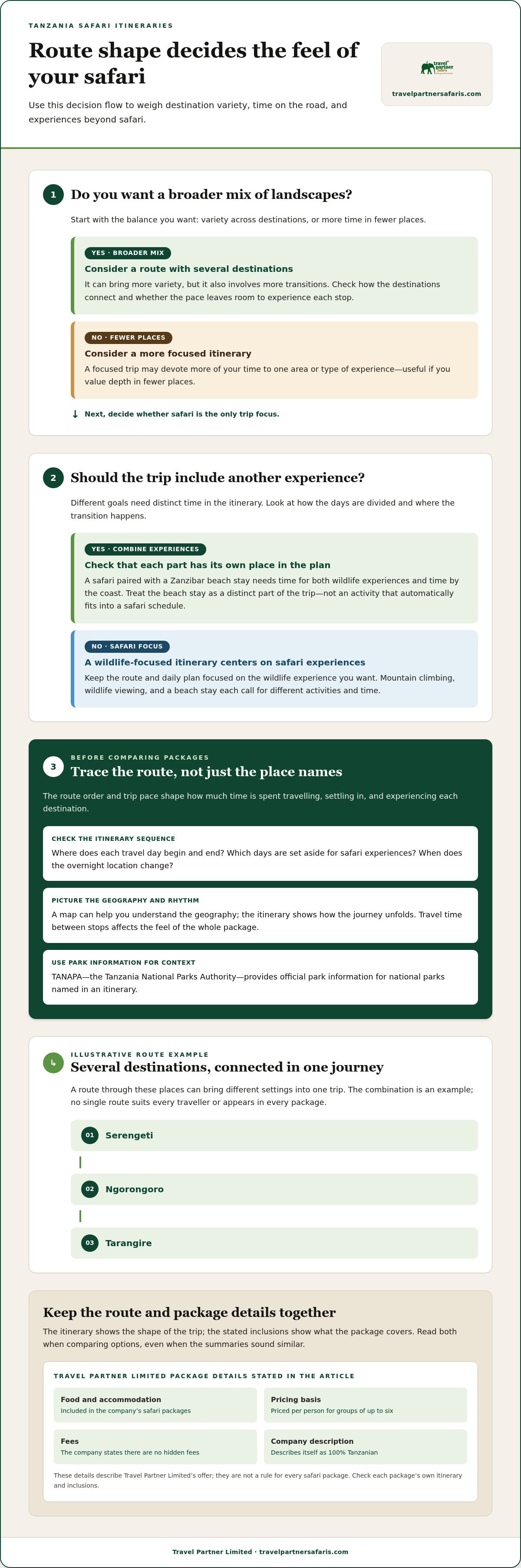
A safari itinerary is more than a list of famous places. Its route determines how destinations connect, how often you change locations, and how much of your trip is spent travelling versus experiencing each stop. A route through Serengeti, Ngorongoro and Tarangire, for example, can bring different settings into one journey. No single combination suits every traveller or appears in every package.
Route order and trip pace matter because they shape how much time you spend travelling, settling in, and experiencing each destination. A focused itinerary may devote more of the trip to one area or type of experience. A route covering several destinations can offer more variety, but also involves more transitions. Neither approach is automatically better. The right balance depends on whether you value depth in fewer places or a broader mix of landscapes.
How do travelers compare different safari route patterns?
Start with the full sequence, not the destination names in isolation. Note where each travel day begins and ends, which days are set aside for safari experiences, and when the overnight location changes. This makes the route’s rhythm easier to picture. A map can help you understand the geography, while the itinerary shows how the journey unfolds.
For a focused trip, consider whether spending more time in one area matches your interests. For a multi-stop route, look at how the destinations connect and whether the pace leaves room to enjoy each one. Travel time between stops affects the feel of the whole package, even when the destinations sound appealing. The Tanzania National Parks Authority (TANAPA) provides official park information to help you learn more about national parks named in an itinerary.
What changes when a safari is combined with another experience?
Adding another focus changes the balance of the itinerary. A safari combined with a beach stay in Zanzibar, for example, needs time for both wildlife experiences and time by the coast. Treat the beach stay as a distinct part of the trip, not as an activity that automatically fits into a safari schedule. Check how the itinerary divides the days and where the transition happens.
Keep different trip goals distinct as you compare options. Wildlife viewing, mountain climbing and a beach stay each call for different activities and time in the itinerary. A package built around wildlife may prioritize park visits; a mountain-focused trip centers on the climb; a combined journey divides time between its parts. Decide which experience matters most, then assess whether the route gives it enough space.
For a practical shortlist, mark each itinerary’s destinations, travel days, overnight stops and main experiences. Compare the overall flow with the kind of journey you want, rather than choosing by the number of named highlights. If you’re ready to explore Tanzania safari package options, use that route-and-pace lens to guide your choice.
Private, Shared, or Tailored: Compare Tanzania Safari Package Styles
Group format changes how a safari is organized and experienced. A private trip is arranged around your party; a shared trip brings you together with other travellers. A tailored package describes an itinerary shaped around preferences, but the label alone doesn’t explain which details can change. Compare the actual arrangements, not just the heading.
Use this quick comparison to identify which questions matter most to your travel group:
Private: Consider whether you want the trip organized around your own party. Look at how the itinerary is planned and what, if anything, can be adjusted.
Shared: Consider whether you’re comfortable following an itinerary alongside other travellers. Check how the group format affects the schedule and shared planning.
Tailored: Look at which parts of the trip are designed around your preferences, and distinguish those from the itinerary’s fixed elements.
These are planning distinctions, not quality rankings. Private doesn’t automatically mean more comfortable or more flexible, and shared doesn’t tell you whether the trip is a good fit. Those details depend on the package. Read the stated group size, route and planned activities rather than inferring them from a label.
When might a private or shared safari suit your plans?
Private travel may suit companions who want the itinerary organized around their party and prefer to plan together as one group. Shared travel may fit people who are happy to experience a planned journey with others. Think about who you’re travelling with, how you like to make decisions, and whether your group’s preferred pace matches the schedule. Neither format guarantees particular wildlife sightings, savings or the freedom to change plans.
For families or friends, compare the group arrangement with everyone’s expectations. Consider whether the itinerary lets your party experience the trip together as intended. For solo travellers or people who enjoy meeting fellow travellers, shared planning may feel natural. The key is to understand how the format works in practice, rather than treating one style as universally preferable.
How should you compare the pace and focus of packages?
Set two options side by side and compare three things: how many destinations they cover, how much time they assign to each, and which activities shape the days. A route with several stops may offer a wider mix, while a more concentrated plan may keep attention on fewer places. Destination count alone doesn’t show how much time you’ll have to experience each setting.
Then name your priority. If wildlife viewing is the main draw, look for an itinerary that gives it a clear place in the trip. If you want a broader mix of landscapes or other experiences, see how those are balanced with safari time. Use the actual sequence and schedule as your guide.
Finally, don’t read comfort or service quality into words such as “private,” “shared” or “tailored.” A label describes one aspect of the arrangement, not every feature of the package. Read the stated accommodation and service details separately. Review meal and accommodation inclusions on their own; the group-style label doesn’t establish what’s covered. This helps you compare Tanzania safari packages by the trade-offs that matter, instead of choosing by name alone.
Plan a Tanzania Safari Package Around Your Dates and Priorities
Start with the practical limits of your trip, not a long list of destinations. Your available dates, total trip length, travel group and preferred experiences give you a useful filter for Tanzania safari packages. Set those first to spot itineraries that fit your plans, instead of trying to reshape your schedule around a package description.
Set your travel dates and trip length. Write down when you can travel and how much time you can spend on the trip. Include any days needed for travel at the beginning or end. This helps you focus on itineraries that fit your schedule and avoid shortlisting a route that feels too compressed.
Describe your traveler group. Note who is going and what the group needs from the trip. Companions may have different energy levels, interests or preferred pace. If you’re planning together, agree on the essentials before comparing package styles.
Rank the experiences you value most. Decide whether wildlife, landscapes, culture or a beach extension matters most. You can still enjoy a mix, but ranking priorities helps you see whether an itinerary gives enough time to the experiences you care about.
Compare the full route and daily rhythm. Look at the sequence of destinations, travel days, overnight stops and planned activities. Then assess whether the pace fits your group and supports your top priority.
Which decisions should you make before comparing itineraries?
Be realistic about how much time you have. A longer wish list doesn’t automatically make a better trip if the available days would require a rushed schedule. If you’re travelling with others, ask each person to name their top experience and preferred pace. Shared priorities can help you choose between a focused wildlife itinerary and one with a broader mix.
How can season and trip pace shape your shortlist?
Season is a planning input, not a promise of particular conditions or wildlife sightings. Seasonal patterns can influence what travellers prioritize, but experiences vary by time and place. Review current conditions for your intended dates and destinations, then compare them with your interests and route. Don’t choose a package on a season label alone.
Pace matters just as much. A route with several stops may offer variety, while a more concentrated plan creates a different rhythm. Check how travel days sit alongside safari experiences and other activities. If a beach stay is important, make sure it has a clear place in the schedule rather than assuming it can be added without affecting the trip’s balance.
Once your shortlist reflects your dates, group and priorities, look closely at the package details. Explore Tanzania safari packages with your preferred dates and trip style in mind.
Choose a Tanzania Safari Package with Clear Expectations
You’ve considered the main factors: your dates, preferred pace, travel group and the experiences you want to prioritize. Now match those choices with a package whose stated details are clear. Inspiration can help you imagine the trip, but understanding what the offer includes and how its pricing is presented helps you make a grounded decision.
Travel Partner Limited describes itself as 100% Tanzanian. Its safari package prices are quoted per person for groups of up to six. The company states that food and accommodation are included and that its packages have no hidden fees. These details are a practical starting point for understanding the offer. Read the itinerary and package information alongside them to see how the trip fits your plans.
What does Travel Partner Limited say its safari packages include?
Food and accommodation are the stated inclusions. Keep that information distinct from other parts of the offer: it doesn’t also describe transport, park fees, activities or other arrangements. Read the package details to understand the itinerary and its terms as a whole. Clear expectations come from knowing which features are stated rather than filling gaps with assumptions.
Per-person pricing for groups of up to six also explains how the price is presented. Consider the group size described alongside the listed inclusions as you review a package. The company’s no-hidden-fees statement supports clarity, and the package information gives you the details needed to understand the trip. A clear picture of the route, inclusions and pricing format helps you judge whether it suits your plans.
What is a practical next step for planning your trip?
Bring your priorities into one short list before reviewing package details:
Your intended travel dates and trip length
The people traveling with you
Your preferred pace and main experience
The package details you want to understand before deciding
Use that list to compare the trip’s stated arrangements with what you have in mind. If a wildlife-focused journey is your priority, consider how the itinerary makes space for safari experiences. If you want a broader mix, look at how the planned trip balances its different elements. Keep your expectations anchored to what the package describes.
There’s no need to choose based on a label alone. Read the offer in context and connect it to your priorities. Travel Partner Limited’s stated inclusions and pricing approach provide a straightforward starting point for understanding its Tanzania safari packages.
Ready to explore? Review Travel Partner Limited’s Tanzania safari packages and consider which trip structure best matches your dates and priorities.
Take the Next Step Toward Your Tanzania Safari
Turn your travel priorities into a short personal brief. Note when you hope to travel, who’s joining you, and what you most want your days to include. Keep it handy as you explore Tanzania safari packages. It gives you a clear way to judge whether a trip fits your plans, rather than getting pulled in by a striking label or a long list of highlights.
As you compare options, focus on the experience you want to bring home. A rewarding choice isn’t necessarily the one with the fullest schedule. It’s the one whose pace and focus make sense for you and your companions. Travel Partner Limited describes itself as 100% Tanzanian, states that food and accommodation are included, and says its packages have no hidden fees. Use those details alongside your own priorities as you decide.
Ready to explore? Explore Tanzania safari packages with Travel Partner Limited and start shaping a trip that fits your plans.
Frequently Asked Questions
Is Tanzania a good destination for a first safari?
Yes, Tanzania can suit first-time safari travellers interested in wildlife and varied scenery. To make the experience manageable, choose a trip length that leaves room to settle in, rather than trying to fit every desired destination into one visit. Think about what would make your first safari enjoyable: unhurried time outdoors, a mix of landscapes or a particular travel pace. Use those priorities to assess each itinerary.
Can I combine a Tanzania safari with a Zanzibar beach stay?
Yes, some Tanzania itineraries combine mainland safari travel with time in Zanzibar, while others focus on safari. A beach stay adds another part to coordinate, so look at how the overall trip is divided. Decide whether you’d rather spend more of your available time on wildlife experiences or set aside a meaningful stretch for a coastal break. Don’t assume a beach stay is part of every package.
When is the best time to book a Tanzania safari package?
There isn’t one best travel period for everyone. The right timing depends on the places and experiences you’re prioritizing, and conditions can vary. Review current guidance for the destinations on your planned route, then compare it with your dates and the trip’s daily schedule. No itinerary can guarantee wildlife sightings. Once your preferred dates are clear, use them to narrow Tanzania safari packages that fit your available time.
How many days should I plan for a Tanzania safari?
Plan around your available time, chosen destinations and comfort with travel between stops. Mark each day as a travel day, an activity day or a rest period. This makes it easier to spot a schedule that leaves too little room for the experiences you value. Compare the complete day-by-day plan, not just the trip length or destination list.
What should I pack for a Tanzania safari?
Pack for your travel dates and planned activities. As a starting point, consider comfortable clothing that can be layered, sun protection, suitable walking shoes, personal medications and chargers for your devices. Your itinerary may affect what’s practical, especially if you’ll be moving between several stops. Keep essentials easy to reach and avoid bringing more than you can manage comfortably. Review current destination guidance before you leave.
Are Tanzania safari packages suitable for families with children?
They can be, depending on your children’s ages, interests and tolerance for travel days. Read the schedule with family routines in mind: consider early starts, time in transit, activity lengths and chances to rest. A route that sounds exciting to adults may feel demanding for younger travellers. Review the package terms for any age-related conditions, and choose an itinerary your family can enjoy together.


Comments